

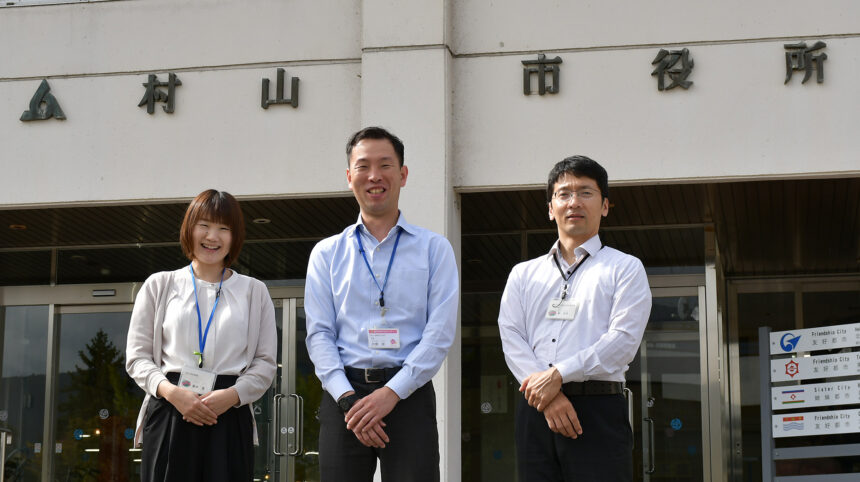
Located in the center of Yamagata Prefecture, Murayama City is surrounded by the Ou Mountains and Dewa Hills to the east and west, and the Mogami River flows through the center of the city, making it a city rich in nature. Mr. Suzuki, who works in the Public Relations and Public Hearing Section of the General Affairs Division of the city, said that he felt there were challenges when it came to promoting the city's attractions through its newsletter and website. While considering ways to improve its public relations capabilities, he learned about Morisawa's training program held in Yamagata City in 2024, and decided to implement this "Communicative Material Design Program."
In addition to Mr. Suzuki, we also welcomed Mr. Mori from the Board of Education, Mr. Katagiri from the Policy Promotion Division, and Mr. Fujita from the Health Division, who all participated in this training, and spoke to them about the purpose and results of their participation.
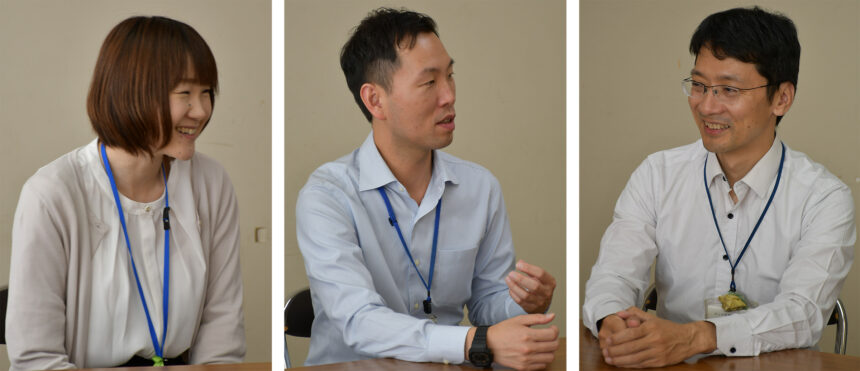
The issue of "materials that are difficult to understand what they are trying to convey"
--Please tell us about the background to the implementation of the training and any challenges you faced.
Mr. SuzukiWhile publishing the newsletter and managing the website, we noticed issues with the content and layout of the articles submitted by each department. Furthermore, requests for inclusion in the newsletter often included information that was not important to the participating citizens, giving the impression that the sender's opinions were too strong. We also saw many documents that were "too long to read" or "hard to understand what they were trying to convey," so we wanted them to organize the information from the receiver's perspective, narrow down the main points, and prioritize.
It was during this time that I learned about the training Morisawa conducted in Yamagata City in fiscal year 2024. After seeing the before-and-after results of the participants' work, I thought, "I definitely want to implement this in Murayama City too." There was also momentum within the city government to improve its public relations capabilities, so the plan and budget were approved, and the event went smoothly.
--What were your thoughts when you took part in the training?
Mr. MoriI was concerned that the materials I created were "difficult to communicate to people." They tended to be wordy, both for external and internal use, and I felt they were "materials that only those who understand them can understand." I decided to participate, thinking that if I could create materials that are easy for the general public to understand, it would also lead to improvements in the materials for internal use.
Mr. KatagiriWhen creating local circulars and event flyers, I would reuse ones made many years ago. However, they were too crammed with text and difficult to read, so I wanted to remake them. Then I saw an advertisement for this training course, and decided to participate, thinking it would help me create easy-to-understand public relations materials.
Mr. FujitaThe Health Department holds a variety of events and activities, including health fairs, so there are many opportunities to create flyers and posters for the public. I also created flyers in my previous job, but because I had no specialized training, I ended up relying on my intuition. I was looking to reassess that, and when I found out about this training, I thought, "This is it!" and decided to take the course.
The set includes lectures, assignments, and corrections, so you can learn and use what you learn next time.
--Is there anything that made an impression on you during the training?
Mr. KatagiriI was surprised that, in a situation where most training sessions are lecture-only, I was given assignments, worksheets, and even corrections. The in-depth content made me feel like I had acquired the necessary skills. If I just listened, I would quickly forget what I learned, and it's not easy to review it in my daily work. However, the lecture-assignment-correction process not only helped me become aware of my own habits, but also gave me specific advice on things like the placement of letters and diagrams, which was very educational.
Mr. MoriThe biggest benefit was being able to learn the theory. The training only involves correcting flyers, but it is not enough to address the issue.I feel that by learning the concepts and techniques, I will be able to apply them to the flyers and materials I create in the future.I also believe that with each production, I will be able to further refine my work.
--Before taking the course, were you aware that you wanted to become proficient in using fonts?
Mr. SuzukiIn most cases, people just use the fonts used in existing documents, and I think few people pay much attention to fonts. At best, they make them bolder or larger when they want to emphasize something.
Mr. KatagiriIn this training, I learned a lot about fonts. For example, I learned for the first time how to use "P" and how to adjust the spacing between characters and lines. Font techniques can be applied not only to flyers, but also to a wide range of situations such as documents and notices, so I would like to make conscious use of them.
Mr. FujitaBecause the Health Department targets people of all ages, from children to the elderly, we had to differentiate between different fonts, such as using a cute rounded gothic font for children and larger fonts for the elderly. In that sense, the font provided as part of the training was very easy to use and we made effective use of it.
Murayama City"Communicative" Document Design Program
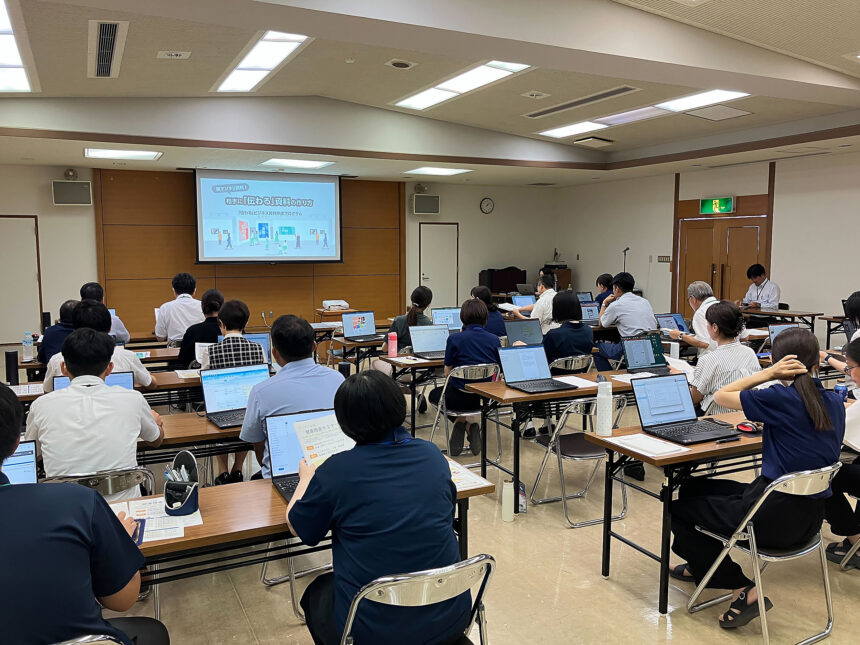
[Part 1: Lectures and group work]
The participants shared in groups what kind of materials they usually create, and also shared their opinions on the flaws in the materials they have been given. Afterwards, they were given specific examples to explain what they should pay attention to when creating materials that "communicate well."
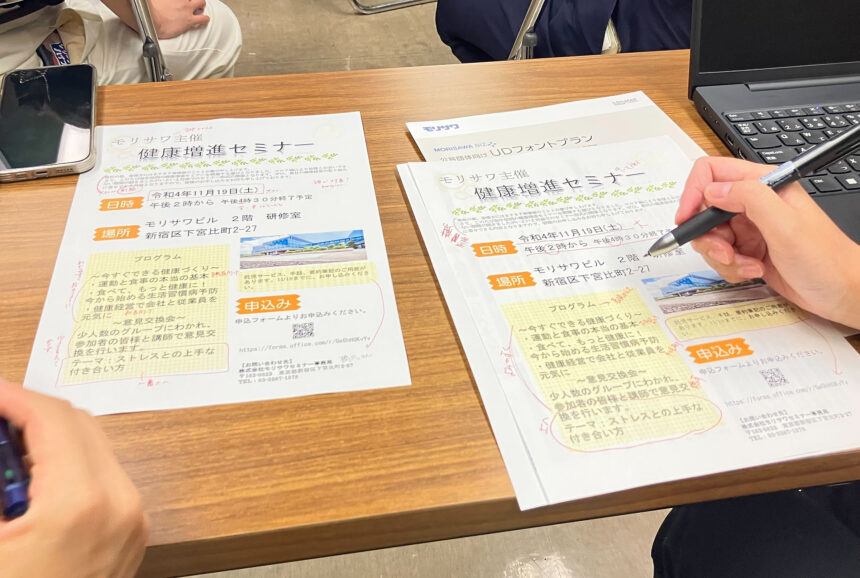
[Part 2: Work]
Using the know-how on creating materials that "communicate" that they learned in the first part of the course, the participants remade materials they had created themselves.
This was an opportunity for participants to ask questions directly to the instructor using their own PCs, and it was a fulfilling workshop with questions about document creation flowing continuously until the very last minute.
[Providing assignments and advice sheets after the course is over]
Any assignments that were not completed during the training must be submitted by the set deadline. After that, the instructor will return the submitted assignments with corrections and an "advice sheet" for participants to review as a reference for future skill development.
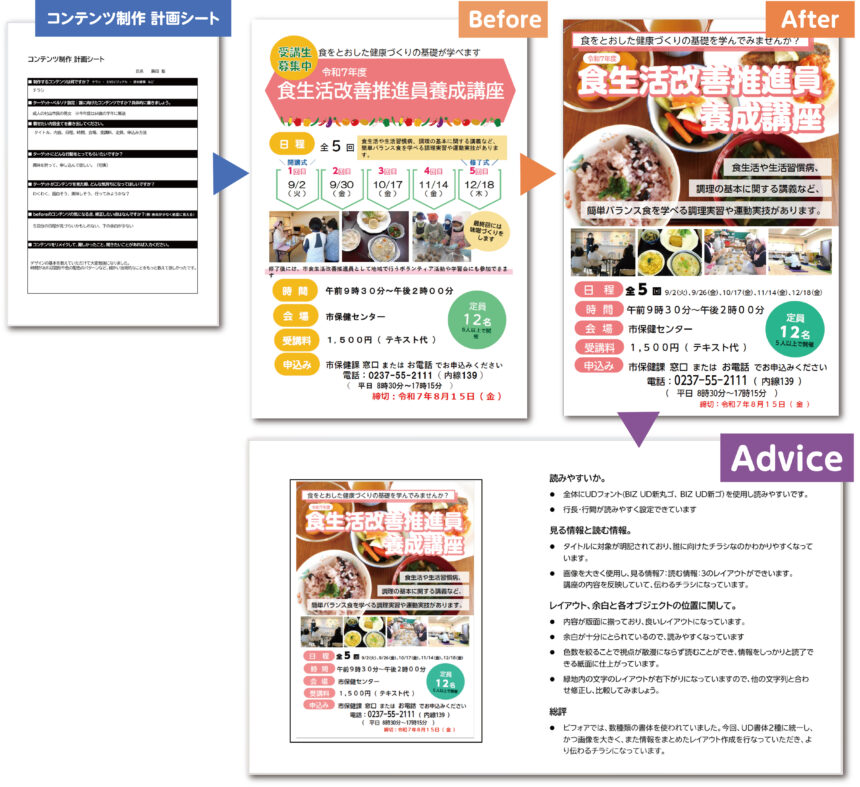
Afterwards, the students reflected on the production process using the "advice sheet" corrected by the instructor (below).
The advice sheet helped participants realize how readability can be improved by giving advice on the ratio of "information to look at" to "information to read," as well as advice on text alignment, line spacing, and margins.
The number of highly designed materials is increasing. We hope to see this spread throughout the agency.
--Have there been any changes in the way you create materials since then?
Mr. KatagiriAfter the training, I was tasked with creating materials, so I immediately put into practice what I had learned, such as adjusting the placement of text and changing the weight to create contrast.
Mr. FujitaA young public health nurse in the same department created a flyer after taking the course, and the design was improved and it looked more sophisticated. I think that staff who have received the training, including myself, are able to create higher quality public relations materials than before.
Mr. MoriThere is another person from my department who is participating, and when I look at the materials he has created, I feel that what he learned in this training is reflected in them, such as limiting the fonts and colors he uses.
Mr. SuzukiI feel that all the participants have been able to put what they learned into practice. The training reports have been shared within the agency, and I would be delighted if they would proactively spread what they learned to other staff members. I hope that this will improve the readability of public relations materials within each section, department, and the entire agency.
Voluntary recruitment led to a wide range of staff participation
--In some cases, this type of training is attended first by managers, followed by field staff. What was Murayama City's thinking?
Mr. SuzukiThis time, we didn't set any restrictions and only accepted those who applied. I think it would have been effective to start by changing the mindset of management, but since it is mostly field staff who actually create the materials, we decided to openly recruit. As a result, a wide range of staff members, from their 20s to their 60s, participated.
--Were there any comments such as, "I would like to take other training like this?"
Mr. SuzukiThis time, the content focused on creating flyers, but some participants said they would like to take the course if it also involved creating documents or plans for internal use.
Local governments have many general training programs for new employees and practical training programs, but I don't think there are any programs like this that are specifically focused on document design. I think the fact that many employees had never had the opportunity to learn about it before and were unaware of it led to participation from a diverse range of people of different ages and positions.
Skills that local government officials who are close to residents should acquire
--Please say a few words to city hall employees across the country.
Mr. MoriI think that many people create materials based on their own intuition, so the work tends to be concentrated on skilled people. However, after taking this training, I felt that anyone would be able to create materials of a certain level.I think that if the staff who understand the content best create the PR materials themselves, it will be more effective. In that sense, I would recommend this training to many people.is.
Mr. KatagiriLocal government officials are close to the residents, and I think they have many opportunities to create materials for residents. Even though they are in a position where they should communicate with residents in an easy-to-understand manner, there are probably few opportunities to learn about the design and layout of materials. "It would be a real shame not to take this training."I think this is a skill that local government officials should acquire.
Mr. FujitaI am extremely grateful for the opportunity to receive this kind of training. In addition, because the program was open to the public, non-regular staff such as administrative assistants were also able to participate. I hope that training opportunities will be made more open and offered to a wider range of staff.
Mr. Suzuki Being able to provide a type of training that local government officials had never received before was an achievement for the organizers.I hope that this will raise awareness of public relations throughout the agency and improve our ability to communicate both internally and externally.
Furthermore, local government employees do not know when or where they will be transferred to. Even if you are not currently creating flyers or other PR materials, if you take advantage of these training opportunities to acquire the skills, you will be able to demonstrate your abilities when you are in that position. Furthermore, I believe that if the number of employees with these skills increases, the communication ability of the entire government will improve.
--Thank you for taking the time to participate in this lengthy interview today.
This "Communicative" Document Design Program ended with the realization that it had significantly changed the awareness of the participants at Murayama City Hall. I was very pleased to hear that the quality of their documents has improved since then. The actual lecture content can be tackled even without prior design knowledge or experience, so I hope you will experience this program for yourself.
Please take a look at the page that provides detailed information about the "Communicative" Material Design Program Training (including costs, the process leading up to implementation, and participant feedback).
Morisawa also offers face-to-face sessions for local governments, schools, and private companies as part of its "Communicative Material Design Program." Details (including costs, procedures, and participant feedback) can be downloaded for free here.
If you are interested in the training sessions for the "Communicative" Material Design Program or the UD fonts used in the training sessions, or if you are considering introducing or utilizing them, please feel free to ask us any questions using the form below.