Machida Design & Architecture College Visual Design Department Graphic Design Department
Professor Kazutaka Kawamura
Machida Design & Architecture College has an educational policy of "developing the ability to find employment as a professional."Morisawa Fonts Educational Institution Plan" (hereinafter referred to as the Educational Institution Plan) was introduced in the spring of 2025 when the service was launched in the Graphic Design Department. We spoke to Mr. Kawamura, who is in charge of the service, about the effects of introducing the Educational Institution Plan and its operational aspects.
| school name | Machida Design & Architecture College |
| Academic area | Architecture Specialist Course – Department of Architectural Engineering – Architectural Design Department – Interior Design Department – Correspondence course (architect qualification) Design Specialization Course – CG Animation Department – Graphic Design Department – Illustration Department – Comic Illustration and Manga Department |
| Implementation Plan | Morisawa Fonts Educational Institution Plan |
| What I was looking for | Improving students' design skills, a stable font environment, and a wide range of support tools |

Supporting each individual and developing skills that can be used in the workplace
Please tell us what students can learn and what is emphasized at your school.
Professor KawamuraOur school offers two specialized courses: architecture and design. Each course has a wide variety of departments, including four specialized courses in architecture (Architectural Engineering, Architectural Design, Interior Design, Correspondence Course (Architectural Qualification)) and four specialized courses in design (CG Animation, Graphic Design, Illustration, Comic Illustration/Manga).
As a vocational school, our educational policy is to provide students with practical skills that can be used in the field. In addition, we have a close relationship between teachers and students, and we are known for our caring attitude, providing careful instruction from the ground up to students with no design experience, so that students can develop the skills to become professionals and get a job.
In recent years, demand for web and digital-related work has increased, and I believe that even graphic-focused companies now mostly handle digital content and video production. As more and more job offers to our school are calling for these skills, we are increasing the proportion of classes in the digital field. Our students are a generation that is more familiar with digital media than paper media, so we feel that starting with the digital field makes it easier for them to get a sense of the practical side of things.
On the other hand, I often hear from designers in the field that they are receiving more requests to create in-house presentation materials and newsletters. I think we live in an age where practical skills are needed to convey information in an easy-to-understand and easy-to-read way.
In addition to price benefits, it also offers stability for continued use.
Please tell us what made you decide to introduce the educational institution plan and about its operational aspects.
Professor KawamuraThe biggest reason is,Price advantage of 900 yen per student per year (excluding tax)The fact that it was possible to introduce it within the department's budget was a major point.
This educational institution plan is being implemented for a total of 82 students in their first to third years in the graphic design department. We heard about it in the winter of 2024 and began using it in time for the service launch in the spring. It took some time due to the busyness of the new semester, but by the end of April it was ready for use in classes. Since then, it has been used for a variety of creative projects in each grade.
Of course, I have been providing guidance on fonts up until now. I have also used fonts other than Morisawa,Instability such as "Required font not found"In this regard, the educational institution plan provides a stable environment that can be used continuously in educational settings. In addition, the typefaces are of high quality, and there are a wide range of typefaces, from standard typefaces to modern typefaces.A wide range of productsAnother attractive feature was the fact that
However, the initial setup of the equipment license via the administrative PC was somewhat difficult to handle. Therefore, we predicted the "frequently used fonts" on the faculty's shared PCs and installed them in advance.The flexibility of online on/off switching for student licenses is very easy to use, so it would be ideal if the equipment could be operated in the same way.The bulk registration of student licenses using CSV data was completed smoothly, and no problems were reported by students.
Being conscious of font selection improves design
What have been the results of the implementation and the reactions of students?
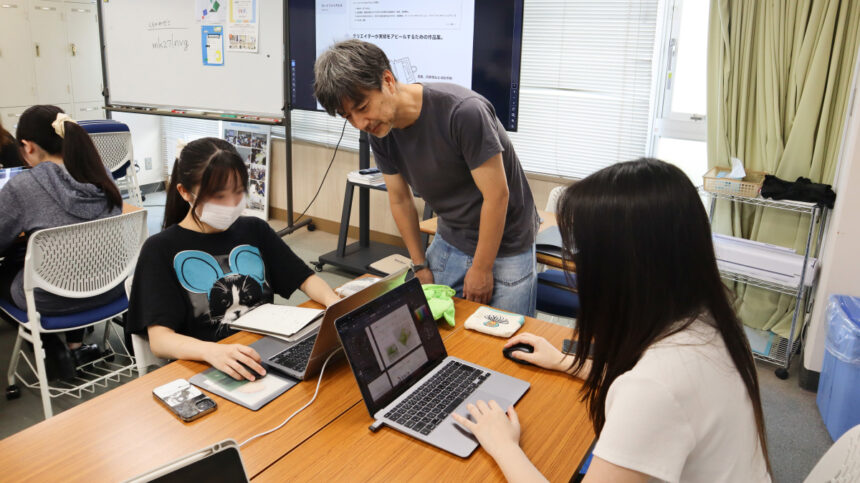
Professor KawamuraI feel that the work of students who pay attention to the nuances of the letters and actively use Morisawa's wide range of fonts has improved the cohesion and completeness of their designs. Of course, it's not just the effect of the font, but I think that paying attention to such small details improves the overall design.
For example, in branding classes, students not only design posters and packaging for the target product, but also websites. Even when the media they are creating are different, using a common font creates a sense of unity and increases the persuasiveness of the design.
Additionally, there is a portfolio creation class in the second semester of the second year. As digital applications have become the norm for document screening in recent years, we instruct students to first create a standard A4 landscape format, and then, once they have progressed to the interview stage, bring a printed version with further refinements. While there is an increasing emphasis on web design in the portfolio content, we try to adjust the proportion depending on the student's field of interest. I feel that Morisawa fonts are useful for even the smallest details, such as the typesetting of titles and main text, and folios.

I want to convey the importance of fonts to all departments.
Please tell us about your future prospects.
Professor KawamuraSince there are many opportunities for exhibitions and presentations in the architecture major, I believe that fonts are highly necessary. First, I would like to verify what kind of effect can be obtained in the graphic design department and share the results.
In such cases, font replacement or changes can be a concern. In educational settings, if you find yourself in a situation where you need to recreate a portfolio and the font you want is missing, this can be a fatal problem.
MorisawaMorisawa Fonts, including the educational institution plan, generally does not withdraw typefaces currently being offered. Although there have been cases where the typeface offering format has changed for some typefaces from overseas foundries, we operate on the premise of providing a stable lineup of our current typefaces.
Professor KawamuraI feel relieved. It's reassuring to know that I can use it stably.
- Students who pay attention to font selection showed improvement in their design skills.
- The wide lineup, from standard typefaces to new typefaces, is attractive.
- A stable environment has been established that allows for continued use in educational settings.
Professor Kawamura, thank you very much for your time and patience during this lengthy interview. Morisawa hopes to continue providing easy-to-use services and conveying the appeal of fonts to students.
For more information about the Morisawa Fonts Educational Institution Plan, please click on the details below.