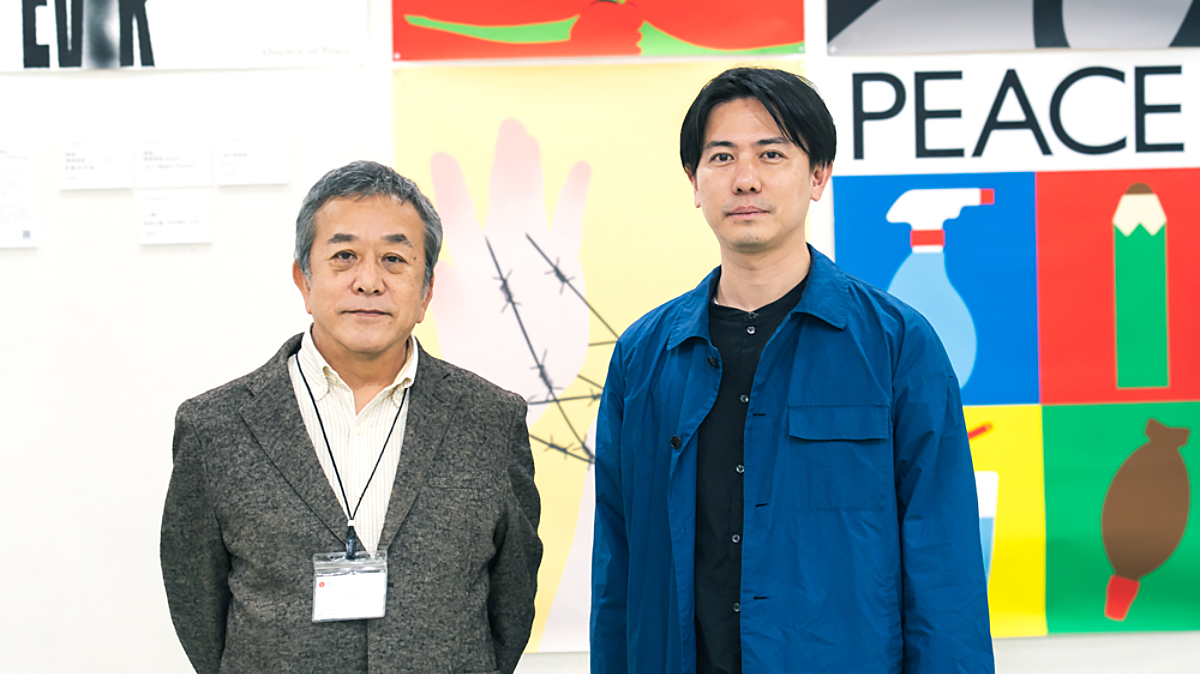
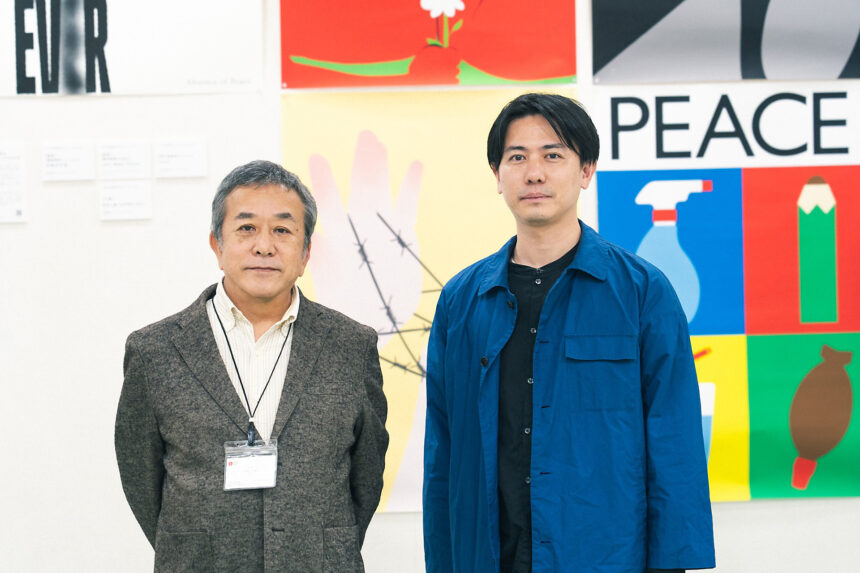
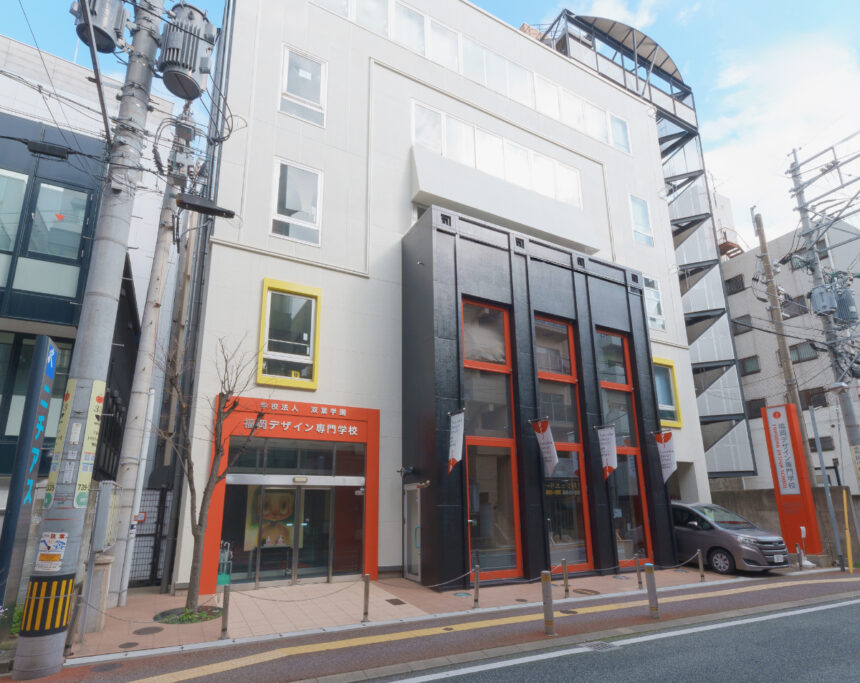
Fukuoka Design College
Chairman Iba(left)
Professor Hatanaka (right)
Fukuoka Design College aims to combine "sensibility" and "reason," and uses "" as a common language to support its practice.Morisawa Fonts Educational Institution Plan (Comprehensive License)" (hereinafter referred to as the "blanket license"). We spoke to Chairman Iba and Mr. Hatanaka of the school, who were among the first to adopt the service after its launch, about the reasons for adopting the blanket license and its effects.
| school name | Fukuoka Design College |
| Academic area | Innovative Design Department (1 year) Creative Design Department (3-year program) – Visual Design Major – Architecture and Interior Design – Furniture and Miscellaneous Goods Product Major |
| Implementation Plan | Morisawa Fonts Educational Institution Plan (Comprehensive License) |
| What I was looking for | Improving teaching efficiency, practical learning, and cultivating students' aesthetic sense |
The need for "sensitivity education" and "ethics (practical) education"
Please tell us what students can learn and what is emphasized at your school.
Chairman IbaOur school's founder was deeply committed to the idea that "school exists for the students." For this reason, we have consistently adopted an educational policy that prioritizes student learning.
In recent years, technological advances such as AI and sensors have been remarkable, but I place importance on human "sensitivity." While AI and sensors can "feel," only humans can connect sensibility with emotion. As long as there are humans at the beginning and end of the creator and recipient chain, I believe education to hone sensitivities is essential.
At the same time, we believe that the information processing that lies between sensitivity and emotion, in other words the "manner" of design, should be made more efficient and faster. Therefore, our school provides an education that combines "education on sensitivity" and "education on manners (practical skills)."
- First year: Sensitivity education (sensitivity training to sharpen the five senses. Sensitivity training using reading and hands-on activities)
- 2nd and 3rd years: Practical design education (basics to applications of graphic design such as typography and layout)
- + 1 year (optional): Deepening research and practice
This 3+1 year curriculum is unusual for a vocational school, but it is based on the idea that short-term training in "how to use tools" alone does not provide students with essential skills.
Professor HatanakaIn addition to the visual design major, our school also offers majors in architecture, interior design, furniture, and product design. Because sensitivity education is important for students of three-dimensional design, it is implemented for all students as part of the first-year basic program.

A turning point in font adoption: Until teachers and students can use the same typeface
Please tell us about the process so far regarding the introduction of fonts.
Professor HatanakaAbout 20 years ago, when I was a student, there were only a few typefaces installed on the school's PCs, and personal font environments were not sufficient. However, as personal ownership of laptops became the norm, design was not possible without the use of the same typefaces outside of school, so the introduction of fonts progressed. Also, around that time, "MORISAWA PASSPORT" was launched, and I think that the fact that it became easier for each student to adopt fonts was a major turning point.
Chairman IbaOur graphics teacher also told us, "It's difficult to teach if students can't use the same typefaces." That said, in the past, each typeface was expensive using Adobe Type Manager (ATM) or printer fonts, so it was difficult to install it across the entire school. Then, with the arrival of MORISAWA PASSPORT, the barrier to adoption was lowered dramatically.
At the time, the DTP environment was also undergoing a period of transition, with changes from Mac OS 9 to OS X, from OCF/CID to OpenType, and from QuarkXPress to InDesign. The integration of OpenType and Adobe applications led to improvements in things like character spacing, and finally, in the educational field, it became possible for teachers and students to use the same fonts.
The appeal of Morisawa is that you can access the same typefaces as the professionals
Please tell us why you chose Morisawa and what effects it has had.
Chairman IbaThis is the result of prioritizing the opinions of designers in the field. The first thing students are asked when they start working is their understanding of type and whether they have a sense of aesthetics and values, so the school must provide an education that can withstand these demands. Fonts can be selected from around the world, but it is important to have an environment where you can quickly access the typefaces you need. Morisawa excelled in this regard, and the convenience of a one-time implementation and high cost performance were also deciding factors.
Professor HatanakaI think the fact that all typefaces can be used is also a key point. It is extremely important for students to be able to use the same typefaces as professionals. Free fonts vary in quality, so we want students to first experience authentic fonts that have been carefully crafted. For this reason, in the common classes held in the first semester of their first year, we provide training in basic typefaces and typography. Students start with standard typefaces such as "A1 Mincho" and "Shin Go," and gradually expand to more advanced typefaces.
Chairman IbaOne of the criteria for judging design is whether the letters sound like a voice. In other words, whether the layout and typesetting have the power to transform the visual into other senses. This is a fusion of education in sensitivity and practical skills, and we believe it is a criterion that also relates to the strength of the design.
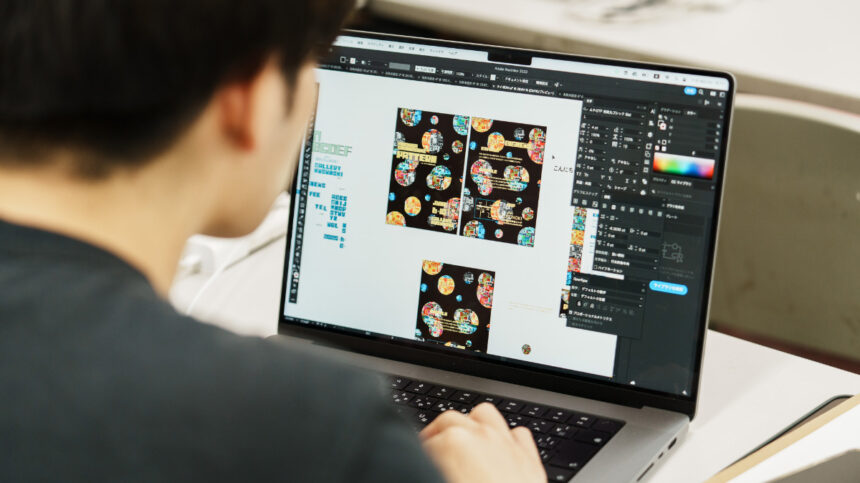
The deciding factors for the "blanket license" are the affordable price and ease of implementation
What was the deciding factor in introducing the "blanket license"?
Professor HatanakaThe deciding factors were the extremely reasonable price for students, the ease of starting to use it by activating it from the browser, and the high searchability. Although the workload on the school side has increased in some areas, we have hardly felt any operational burden.
However, this year, we did not issue email addresses for students, and instead used Gmail and other services, which caused problems with communication. We would like to consider revising the account design in the future.
Value as a "common language" that breaks down barriers between fields
What about applications outside of the graphics field?
Chairman IbaThere was a time when only students in graphic design used fonts. However, written information is essential in other majors as well. For example, architecture students not only create signage plans, but also presentation boards and exhibits. No matter how excellent the design or planning, if the text that conveys the content is poorly written, it will not be readable.
Professor HatanakaThere are many examples of world-class architects who create their own graphics. That is why I would like students of other fields, including those in graphic design, to come into contact with well-formed typefaces and develop their aesthetic sense.
Chairman IbaIn that sense, I think it is very significant that a blanket license will eliminate the barriers between disciplines. I feel that it is extremely important that students from all majors can learn in the same environment, in other words, that the font environment serves as a common language.
- Since teachers and students use the same environment and font, classes are conducted at the same level.
- With a wide variety of family typefaces and design typefaces, you can learn practical trial and error in character placement, character spacing, typeface selection, etc.
- Exposure to professional-quality fonts develops aesthetic sense
- Cultivate the ability to evaluate works based on whether the letters can be perceived as sounds or voices.
Collaborating with educational institutions to create a cultural sphere rooted in the local community
Please tell us about your future prospects.
Chairman IbaI don't think culture flows unilaterally from Tokyo. Osaka has its own culture, and Fukuoka has its own culture. I think culture is about each region protecting its own independent aspects while mutually enhancing each other.
That's why I think it's important for local educational institutions to create a common environment and fonts. Increasing the number of such common languages will make it easier to hold exchange classes and build closer relationships. I hope to nurture local designers, expand communication within the region, and create a cultural sphere that is rooted in the community.
Morisawa Fonts is a common language that is essential for "sensitivity education" and "ethics (practical) education."
Fukuoka Design College aims to nurture designers who combine "sensibility" and "reason." The Morisawa Fonts Educational Institution Plan (Comprehensive License) is an essential "common language" that supports this philosophy. By having both faculty and students study in the same professional typeface environment, aesthetic sensibilities are cultivated and the quality and efficiency of instruction is improved.
This does not merely provide tools, but also leads students to a deeper study that allows them to perceive text as a "voice." Going forward, we will be keeping a close eye on the school's challenge to expand this common foundation to local educational institutions and build a design culture rooted in the local community. The future of design education is being carved out by a solid environment and passionate ideals.